Showing posts with label Science. Show all posts

Friday, February 20, 2015

Arctic Blast


The kindergarteners, first and second graders have been busy doing research about polar region animals.  The kindergarteners learned about four different kinds of penguins.  First graders learned about polar bears.  Second graders learned about a variety of arctic animals. 


First, I shared the signed copy of the book, One Cool Friend by Toni Buzzeo with the kindergarteners. While a small group of students learned about a penguin, the rest of the class was able to practice sight words and math skills with penguin themed activities.  Life-sized penguins took over the media center so students were able to get a better idea of the actual size of these “proper” birds.  They were able to use nonstandard measurement to compare the height of the five types of penguins displayed. Students loved doing yoga with Pedro the Penguin.  After groups of 4-5 students learned about one penguin, using PebbleGo,  they typed what they learned in an Animoto.  Some students displayed what they learned beside the life-sized penguin. Students also labeled a penguin. Thanks to Kindergarten Crayons.


Letter Match/Alphabetical Order -Cricut Create a Critter
Polar bears were the topic for the first graders.  First we talked about the Super 3 research process.  For the planning step, they used an ARE, CAN, HAVE graphic organizer to take notes.  Students used the links on the K-2 Symbaloo that I created for them, PebbleGo, and information that we learned from the book Knut: How OneLittle Polar Bear Captivated the World by by Craig Hatkoff and others.  Some students were able to dig a little deeper using QR codes to find the answers to questions about polar bears. Look for the Polar Bear QR Code Webquest at Emily Gibbons Teachers Pay Teachers store.   While students used their notes to do a report, one student at a time experimented with blubber.  One sentence from the completed reports was chosen for the student to type into an Animoto video.  Some students will present their information in a ChatterPix.  The students viewed the presentations and we discussed what we learned and how we felt about each presentation.  The review concluded our Super 3 process.  Students were excited to tell their teachers what they learned.
Polar Bears
Polar Bear at NC Zoo

The second graders learned about some interesting animals in arctic regions.  Using library books, magazines, links from our K-2 Symbaloo.  Students found as much information as possible to share with the class.  We did the same experiment as the first graders.  It was “cool” to see how blubber keeps the arctic animals warm.  One second grade class used the ARE, CAN, HAVE graphic organizer, while one class used a graphic organizer by Tiffany Reed, that required them to explain the anatomy (size, color, and appearance), habitat, diet, and interesting facts.  Some students used Animoto or Chatter Pix to present their information.  Others will present their information with a lapbook.   
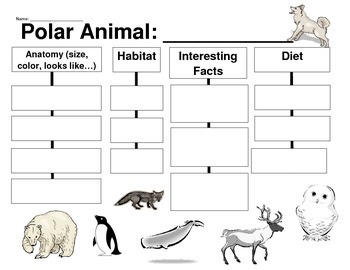
Polar Animal Graphic Organizer


Blubber Experiment

I might use the life-sized penguins and lapbooks in combination with the Animoto videos and ChatterPix via QR codes for Digital Learning Day.  What are you doing for Digital Learning Day?

Friday, April 6, 2012

B For Beekeeper

Whenever we read, Busy Buzzy Bee in our Harcourt Trophies reading series, we try to get someone to talk to our first graders about beekeeping.  This year we were very fortunate to get Bill Waddell to bring one of his hives, his beekeeping suit, a smoker, and a sample of honey.  The students were able to handle and observe a honeycomb.  Two students were able to try on the beekeeper bonnet.  All of the students were able to sample some honey.  They were fascinated by all the bees in one hive, and tried to find the queen.  They were more amazed to know that Mr. Waddell only brought a small portion of his bees with him.  He shared a YouTube video in which he was featured; Bee For Beekeeper.  There are two parts to the video.  Check it out.


Mr. Waddell goes all over the world with his bees. He has been to the Dominican Republic and Venezuela.  I ran into him at the NC Zoo back in the fall.  I bought two bottles of honey from him. When I realized that he lived in the city next to me, I asked if he knew a former neighbor who was also a beekeeper.  Throughout our conversation, I realized that he and my neighbor came to another school where I was an assistant.  He said that he would be happy to come talk to our first graders. 

Our first grade classes wrote about worker bees and queen bees.  Their writings are displayed in the hallway.  I think I'll add some of the pictures that were taken during our guest speaker's visit to the display.


Sunday, March 18, 2012

Bloomin' in First Grade

Back in the fall, my students planted 50 tulip bulbs, for a Journey North project.  Throughout the last part of the year, we checked the temperature and added mulch.  We got our first sprout at the end of January.  Our very mild winter forced several flowers to wake up early. 
Can You Dig It
Teamwork
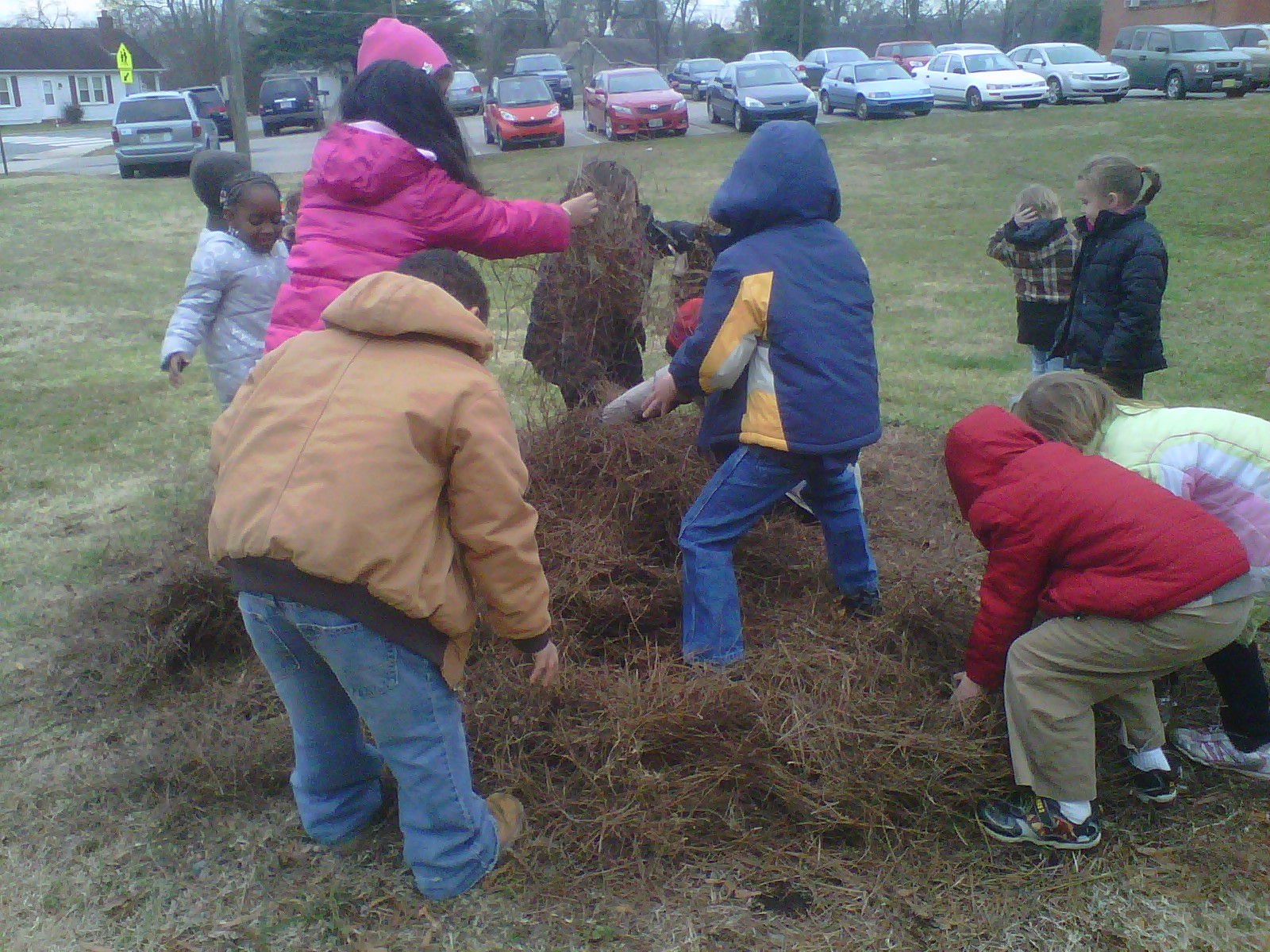
Spreading Mulch on a Cold Day

Then the snow came.  I tried to prepare the students for the disappointment that might come.  Then we noticed more sprouts and at least one bud.  Finally, this week, our first tulip opened up.  Then there were so many tulips that we had a hard time counting them.  The students wanted to stop and count them every time we passed them.  We did stop to measure the leaves.  They got their chance to count them when a substitute took over for our 1/2 day workshop.  They used yarn to group the plants in tens.  They counted 37 plants.  I think about twelve had actually bloomed by then. 
Wake Little Tulip
Our First Tulip

The students are so proud of their hard work.  The teachers keep telling them what a great job they did.  All I did was take pictures and video.  The students really did do the digging and planting, because I don't like worms.  So much for my garden theme.  Right?  Our next gardening project will be to plant some vegetables and flowers in one of the school's garden plots.

Which One Did You Plant?

Saturday, February 4, 2012

Groundhog Day

We read Groundhog Weather School by Joan Holub. Then we made our own groundhog, Brownie.  The day before Groundhog Day, the students used a math activity to help predict whether the groundhog would see its shadow or not.  Students used dice in dice to create addition problems.  If the sum was even, the students colored that number of blocks in the no shadow side of a graph.  If the sum was odd, they colored that number of blocks on shadow side. We graphed the students' results as a class.  The shadow side won.:(  Students also made an accordion book with information about Groundhog Day.

On Groundhog  Day, we planted Brownie in an open spot in front of the school.  On the way from PE, we checked to see if he saw his shadow.  He did.  We used cubes and measured his shadow at about 9:00.  Brownie's shadow was 45 cubes long.  I asked the students to think about the book we read, and what it said about shadows on the wall in relationship to the distance of a flashlight.  I also showed them where the sun was positioned that morning.  I asked them where the sun would be in the afternoon.  When we returned to the classroom, I gave them a sticky note, told them to write their name, and write whether the shadow would be longer, shorter, or stay the same. Everybody except for one student wrote that the shadow would be longer. One student said the shadow would be the same length.  I read the part about a flashlight and shadows on the wall again. I then asked if anyone wanted to change their answer.  Nope.

Brownie

After lunch, we visited Brownie again.  Not only was the shadow SHORTER, it had changed positions.  The shadow now measured 18 cubes long.  Wow!!!  I guess I should've demonstrated instead of just showing the pictures in the book.
Classmates prompted this student to take some cubes away, to make it even with the shadow.

To be honest, six more weeks of the spring-like weather that we've been having is okay with me.  I just hope our tulip garden project will survive if the temperatures drop.

Thursday, November 3, 2011

Journey North Tulip Garden Project

This week, we planted 50 Red Emperor tulip bulbs for a Journey North project.  The students will be scientists for the next few months.  They will watch the weather, check the temperature, make observations, and keep a journal. 

I am encouraging the students to plant some tulip bulbs at home, so we can compare the growth.  As a class, we will be comparing our tulip garden to other classes across the country.

We can't wait for the tulips to bloom in the spring.  We're hoping the squirrels will fill up on acorns, and leave our bulbs alone.

Teamwork

7 inches deep, 4 inches apart

Our Young Photographer Took a Break

Ooops! Too Much Digging